2027 could mark autonomy’s shift from proof to scale. Durable advantage will come from two things: lower consumer cost and an operating model that scales across vehicle production, fleet operations and finance. The constraints around that system will take years—not quarters—to work through.
The robotaxi fleet more than doubled to 8,000 vehicles across 20 cities in 2025. One analysis puts shared-autonomous-vehicle revenue at $610 billion to $2.3 trillion by 2040.
The U.S. combines technology, capital and scale. Against 271 million registered light-duty vehicles, the Uber and Lyft network is estimated at three to four million. High fares and driver costs create valuable arbitrage. At lower autonomous prices, robotaxis compete not only with ride-hail, but car ownership. Uber and Lyft used subsidies to build the market; autonomy could make lower prices structural.
Competition is also constrained. From model year 2027, U.S. security rules prohibit sales by connected-vehicle manufacturers with a sufficient nexus to China or Russia, and vehicles using covered software. This materially narrows the field for Chinese AV platforms without amounting to a blanket ban. China is scaling deployment, while the UAE offers a coordinated regulatory testbed. Each is turning autonomy into a transport system.
A self-driving vehicle is not automatically a fleet asset. It still needs approval, manufacturing, depots, charging, grid access, maintenance, support, insurance and finance.
The bottleneck moves downstream.
The Rulebook Is Catching Up
Twenty-nine U.S. states have enacted autonomous-vehicle laws, mostly providing frameworks for approving operations rather than detailed rollout plans. The patchwork remains, but autonomy is no longer confined to a handful of exceptional pilots.
At the federal level, autonomy is now an innovation and competitiveness priority. NHTSA’s framework moves toward a unified approach by modernising standards, removing obsolete design rules and expanding deployment pathways.
Operators must still prove safety and integrate with states, cities and emergency services. But regulation is increasingly enabling commercial deployment rather than simply blocking it.
2027 Is the Growth Inflection Point
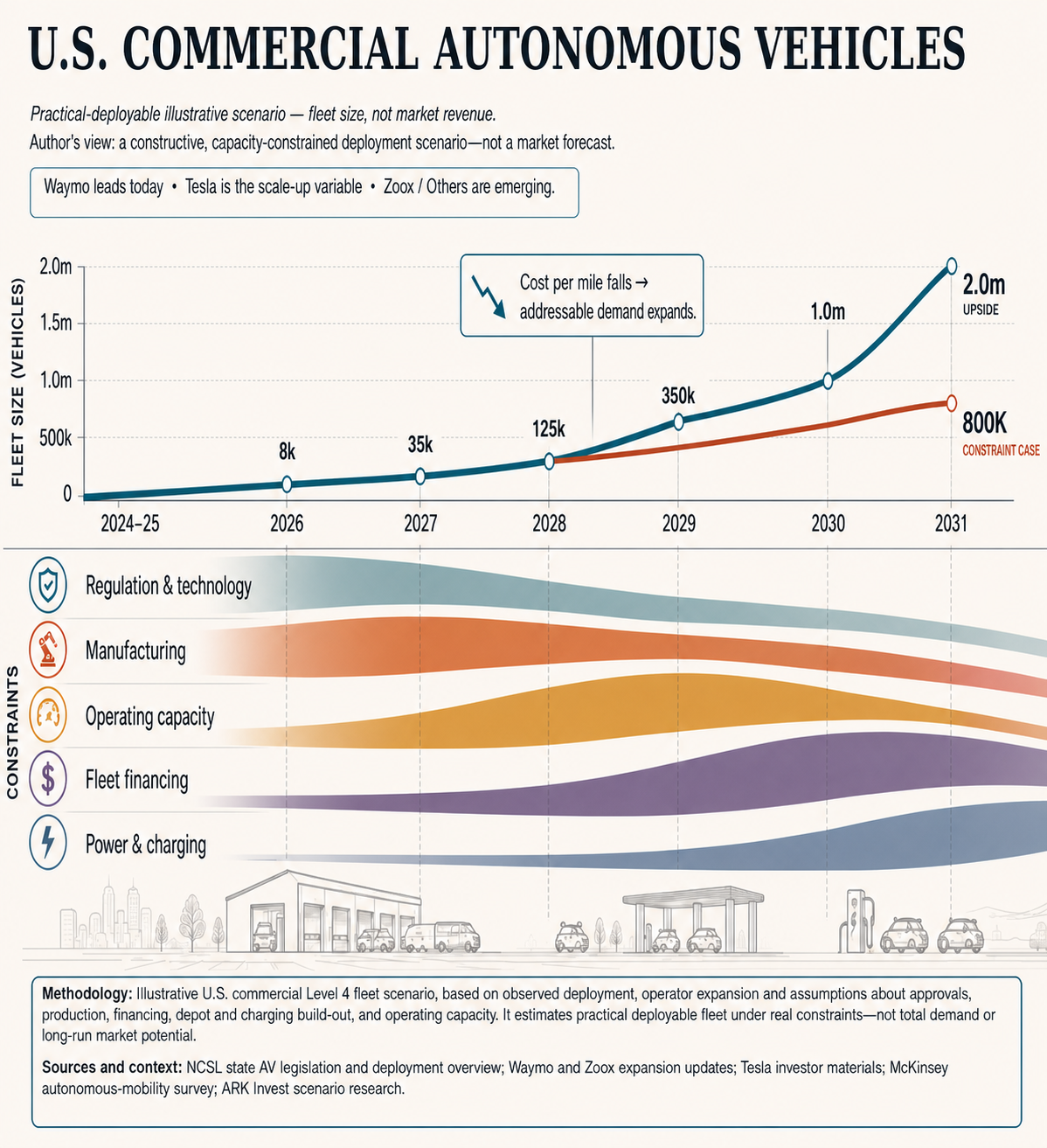
The chart is not a market forecast. It is an illustrative, capacity-constrained view of how the U.S. commercial autonomous fleet could scale—and how the binding constraint changes as it does.
The key signal is the bend beginning in 2027. In this scenario, the fleet rises from approximately 8,000 vehicles in 2026 to 35,000 in 2027, then jumps to 125,000 in 2028. That is an increase of 90,000 vehicles in one year, or roughly 3.6 times the 2027 base.
What matters is not the precision of 35,000, but the transition it represents: from proving autonomy in selected territories to replicating an operating model across cities. As safety evidence and regulation improve, manufacturing and operations take over. At scale, finance, depots, charging and grid connections become decisive.
Proof Is Not Scale
Level 4 systems must handle rare events, emergency vehicles, roadworks, vulnerable road users and system failures within a defined operating domain. Evidence from one city cannot simply be copied into another; road geometry, weather, driving behaviour and emergency procedures differ.
The deployment gap is already visible. Waymo now serves riders in 11 U.S. metro areas and lists 19 more U.S. cities as “up next.” Tesla’s Robotaxi service is offered in limited areas of six cities: Austin, Dallas, Houston, Miami, Orlando and Tampa.
The categories must remain clear. The Tesla product available to private owners today is FSD (Supervised), which requires active driver supervision; Robotaxi is a separate, unsupervised service. The question is not whether Tesla intends to move beyond supervision, but how quickly it can validate, regulate and operationalise that transition at scale.
Approval proves a system may operate. It does not prove it can scale.
Autonomy Becomes an Operations Business
Once a service works, operators need vehicles quickly enough—and cheaply enough—to support commercial economics. Purpose-built robotaxis can improve durability and utilisation, but require committed supply chains, sensors, compute, batteries and assembly capacity. Software distributes instantly. Fleets do not.
Every market also needs mapping, dispatch, cleaning, maintenance, roadside response, incident management, remote assistance and trained local teams. Vehicles that are charging, awaiting maintenance or repositioning empty are capital that is not earning.
Scaling autonomy is therefore an industrial operating problem: putting thousands of vehicles into dependable, high-utilisation service, then reproducing that system city after city.
The Bottleneck Moves to the Balance Sheet and the Grid
Public charger counts are a poor measure of fleet readiness. High-utilisation fleets need land, depot design, grid connections, dependable chargers, maintenance and energy management. In constrained cities, permitting and network reinforcement can delay depots for years—and cap fleet size.
Finance must evolve in parallel. Pilot fleets can sit on corporate balance sheets. Replication requires capital for vehicles, depots, chargers and grid upgrades before revenue matures.
Those assets become financeable when operators provide credible data on mileage, utilisation, energy, downtime, maintenance, incidents, revenue and residual value. Over time, that evidence could support innovative financing options—including lease or debt payments linked to revenue-generating miles and potentially tokenised real-world-asset structures. These could broaden capital access and reduce funding costs, but only after performance histories, residual values and investor confidence mature.
The Winners Will Own the System
The driving model will keep improving, and safety will remain fundamental. But the winners will be those that coordinate the full system: approvals that travel, factories that deliver, operations that sustain utilisation, depots that work, power available when required and capital ready for the next city.
Self-driving was the “easy” part. Scaling the operating system around it is where the market will be won.
The UAE Is a Trailblazer, Not a Footnote
The UAE belongs in this discussion because it is treating autonomous mobility as a strategic national capability. Dubai targets 25% of all trips across transport modes to become autonomous by 2030, while regulators, infrastructure agencies, operators and global technology companies are working within one coordinated deployment model.
This is no longer theoretical. WeRide and Baidu’s Apollo Go are available through Uber in Dubai, creating what Uber calls its first multi-partner autonomous network globally. Riders can select an autonomous option or be matched through UberX and Uber Comfort. Pony.ai is among the additional companies working with Dubai’s RTA on autonomous deployment.
The United States, China and the UAE are not pursuing identical models. That is precisely why they matter. Together, they represent three leading approaches to the global autonomy race: private-sector innovation and capital, deployment at scale, and state-coordinated regulation and infrastructure.
Sources (18)
- International Energy Agency — Autonomous Vehicles
- McKinsey Global Institute — The Next Big Arenas of Competition
- National Conference of State Legislatures — Is the Economy Ready for More Autonomous Vehicles?
- U.S. Department of Transportation — Automated Vehicle Framework
- NHTSA — Automated Vehicle Performance Standards and Deployment Actions
- U.S. Bureau of Industry and Security — Connected Vehicles Rule
- Waymo — Where We Operate and What’s Up Next
- Waymo — Safety Impact
- Tesla — Full Self-Driving (Supervised)
- Tesla — Robotaxi Availability
- Tesla — Q1 2026 Update
- McKinsey — The Road to Affordable Autonomous Mobility
- McKinsey — Truck-as-a-Service: Usage-Based Fleet Financing
- Federal Highway Administration — U.S. Vehicle Registrations, 2024
- International Energy Agency — Global EV Outlook 2026: Charging
- UAE Government — Dubai Autonomous Transportation Strategy
- Uber — Dubai’s First Multi-Partner Autonomous Network
- Dubai RTA — Pony.ai Autonomous-Vehicle Programme
Share the definitive article from ianohan.com.