
My message to UAE boards today is direct: stay agile through Q4, but prepare the people, suppliers, systems and cash needed to accelerate in Q1. Do not commit to fixed expansion before demand proves itself—but do not wait until the rebound is obvious to everyone before getting ready.
That conclusion comes from the recovery timeline, not a headline growth number. The outlook is national, but Dubai provides the clearest high-frequency evidence of how demand, mobility and confidence are moving.
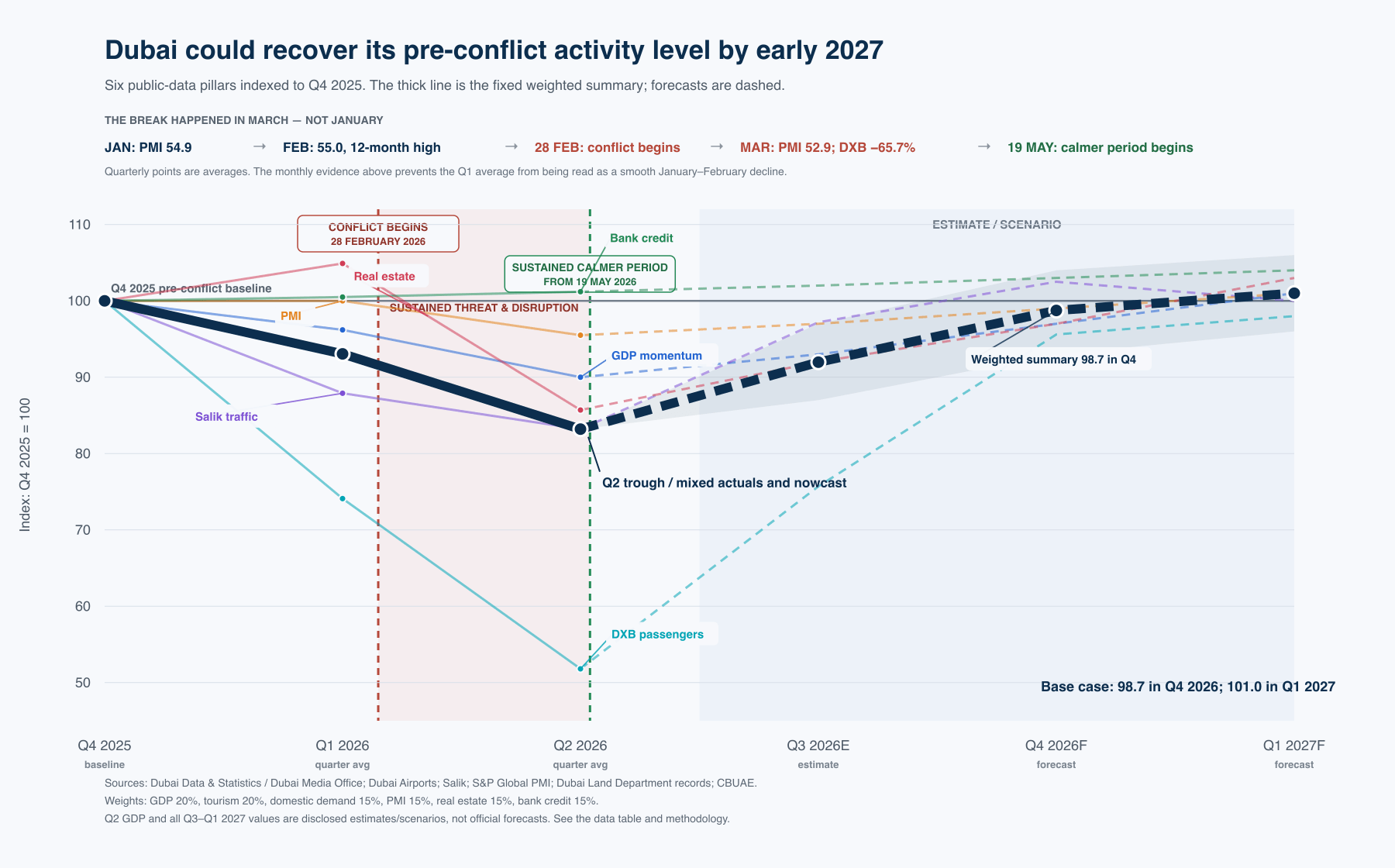
January and February were still months of expansion. The regional conflict began on 28 February, and March was the break. The period of sustained material threat lasted into May. On the evidence available today, Q2 was the trough. Our base scenario then puts Dubai’s weighted activity measure at 98.7 in Q4 2026 and 101.0 in Q1 2027, against the immediate pre-conflict baseline of Q4 2025 = 100.
That is the finding: Dubai could be almost back to its pre-conflict activity level by the end of this year and slightly above it in early 2027. It is a scenario, not a promise—and the recovery is uneven.
The quarterly data underneath the index
Natural-unit evidence and disclosed analytical scenarios by quarter.
| Pillar and natural unit | Q4 2025 actual | Q1 2026 actual | Q2 2026 actual / proxy | Q3 2026E | Q4 2026F | Q1 2027F |
|---|---|---|---|---|---|---|
| Dubai GDP growth, YoY | +6.4% | +2.4% | −4.2% nowcast | −1.0% | +3.2% | +7.5% |
| DXB passengers | 25.1m | 18.6m | 13.0m | 19.0m | 24.0m | 24.6m |
| Salik total trips | 224.3m | 197.2m | 186.6m* | 218.0m | 229.9m | 224.3m |
| UAE PMI quarterly average | 54.3 | 54.3 | 51.8 | 52.6 | 53.7 | 54.8 |
| Dubai real-estate transactions | 57,510† | 60,303 | 49,286 proxy | 52,909 | 55,785 | 59,235 |
| UAE gross bank credit | AED2.49tn | AED2.50tn approx. | AED2.52tn approx. | AED2.54tn | AED2.57tn | AED2.59tn |
| Weighted dashboard index | 100.0 | 93.1 | 83.2 | 92.0 | 98.7 | 101.0 |
Q4 2025–Q2 2026 values are published actuals except where marked as a proxy, approximation or nowcast. Q3 2026–Q1 2027 values are analytical scenarios—not official forecasts.
Salik Q2 is calculated from the published half-year total less Q1. The Q4 2025 property figure is a DLD-record aggregation rather than a separately published DLD quarterly headline.
The GDP row translates the indexed growth-momentum scenario into an implied year-on-year rate; it is not a forecast of absolute quarterly GDP.
The shock tested more than the economy
After 30 years in the UAE, I think the shock answered a question that had always sat quietly in the background: what would happen if the country were attacked? By 16 May, the UAE Ministry of Foreign Affairs said nearly 3,000 missiles and drones had been launched toward the country. There were casualties and real disruption. But most incoming weapons were intercepted, critical systems held and daily life continued. The UAE did not prove itself invulnerable; it demonstrated that it could take an extraordinary shock and keep functioning.
Resilience is now compounding. The UAE already had a crude pipeline to Fujairah that bypasses the Strait of Hormuz and is accelerating a further US$3 billion pipeline targeted for 2027. Saudi Arabia used its East–West pipeline to Yanbu at full capacity during the crisis, while the Port of NEOM is expanding Red Sea trade capacity. These routes do not eliminate risk, but they create more ways to keep energy and goods moving.
The dashboard is supported by UAE-wide business-activity and credit indicators. It is not an official forecast or a complete index of the national economy. Where quarterly official data are unavailable, it uses disclosed proxies or scenarios rather than presenting estimates as facts.
Q1 contained two stories: January and February were still expanding, then March absorbed the shock. Dubai GDP still grew 2.4% year on year and property transactions rose 6%, but DXB passengers fell 20.6% and Salik trips 6.4%. Q2 was weaker: DXB traffic was roughly 42% below Q2 2025, Salik trips fell 12.6% and the PMI average slowed to 51.8.
Capital held up better than mobility. Corporate credit and DFM trading increased, but venture deal count fell while funding concentrated in a few larger rounds. Money did not disappear; it moved through fewer decisions.
Our base scenario puts the Dubai-led weighted dashboard at 98.7 in Q4 2026—close to, but still just below, the Q4 2025 pre-conflict level—and at 101.0 in Q1 2027. The shape matters: this is a potential snapback from an unusually depressed Q2 base, not ordinary steady growth. That depends on air capacity continuing to return and the region avoiding another major disruption. The forecast points are deliberately labelled and should be read as a direction and range, not as an official forecast for either Dubai or the UAE as a whole.
For a business owner, that is the practical message: get ready to do business again. Stay agile through Q4 and prepare to respond to a potentially fast return of demand in Q1—but do not assume every market will recover together. Build flexible capacity, keep cash and decision rights close to the operating team, and scale when customer demand proves itself.
These are the seven Q4 directives I would put to the board.
1. Manage the P&L, not the headline
What the board should do: Reforecast every business line using actual demand, margin and cash. Do not let a positive national number hide weakness—or opportunity—inside the company.
The IMF expects 2026 UAE activity to finish below 2025, with tourism, transport, trade and real estate carrying much of the non-oil drag. The CBUAE forecasts 1.7% growth. Yet parts of Dubai’s economy expanded in Q1. National resilience and company weakness can coexist.
Returning passenger numbers will not automatically restore tourism profitability. Source market, length of stay, room rate, spending and acquisition cost may recover differently.
2. Agree the disruption decisions before you need them
What the board should do: Set the triggers, backup routes and decision owners now. Disruption can change faster than the board can meet.
Businesses reroute, insurers reprice, airlines restore capacity and customers adapt. An isolated diversion or alert is not automatically another Q2. Ask four questions: did it constrain capacity, change demand, raise the cost to serve or threaten continuity? If not, monitor it. If it did, activate the pre-agreed response.
3. Protect margin as local costs rise
What the board should do: Test customer affordability and the full cost of serving demand before changing prices, hiring or expanding.
Dubai inflation reached 5.33% in July, led by transport, food and housing-related costs. A fast demand snapback could collide with labour and transport capacity. Track permit lead times, critical-role vacancies, driver availability and wage pressure before service levels fail.
4. Turn government alignment into operating readiness
What the board should do: Clear the immediate deadlines and show what the company is building locally. Government opportunity goes to businesses that can operate, comply and deliver in the UAE.
Dubai plans AED99.5 billion of expenditure in 2026, with infrastructure accounting for 48%. But a public budget is not automatically an addressable pipeline. State what the company will build locally and clear the immediate gates: calendar-year taxpayers generally face a 30 September corporate-tax deadline, while businesses above AED50 million revenue must appoint an accredited e-invoicing provider by 30 October.
5. Protect cash; assume new funding will take longer
What the board should do: Start financing early, speed up collections, review treasury and investment exposure, and commit only when funding and payment are clear.
The banking system is strong, but that does not guarantee every company its preferred amount, price or terms. DFM trading rose, while MAGNiTT reports that venture funding increased even as deal count fell 37%. This is not a capital drought. It is concentrated conviction.
6. Make trade provenance—and supply-chain resilience—a board issue
What the board should do: Prove where critical goods come from and how they move, then build alternative suppliers and routes before increasing US-bound volume.
The UAE’s first-half non-oil trade value reached AED1.937 trillion. A White House report also raised concerns about illegal transshipment through the UAE. These are US enforcement claims, not adjudicated findings, but companies moving goods into the United States should treat supplier provenance, substantial transformation and country-of-origin evidence as strategic operating issues.
The disruption around the Strait of Hormuz showed why provenance alone is not enough: a company can know exactly where its goods come from and still be unable to move them. Map exposure to chokepoints, concentrated suppliers and single-route dependencies, then establish the alternative sources, logistics paths and inventory buffers needed to keep trading through another disruption.
7. Make AI a critical strategic priority—and fund the capability to execute
What the board should do: Make AI a critical company-wide strategic priority. If no dedicated capability exists, establish an executive-sponsored AI task force or skunkworks with ring-fenced people, budget, technology access, decision rights and a 90-day delivery plan.
The new federal Artificial Intelligence and Data Authority makes the direction clear: AI is becoming strategic infrastructure, not a side experiment. Treating it as a collection of pilots will not build repeatable capability. Give the task force authority to work across functions, resolve data and access barriers, and select three workflows where AI can materially change revenue, cost, decision time or losses. Give each workflow a named business owner and a measurable result to prove within 90 days.
Do not allow the skunkworks to become an isolated laboratory. Every successful proof needs an operating budget, an adoption plan and a defined route to scale across the company, with cybersecurity, governance and human accountability built in from the start.
What could delay the recovery in Q1 2027?
The base scenario assumes that adaptation continues and that further regional events do not automatically recreate the Q2 shock. Five specific operating risks could still push the recovery back:
- renewed regional escalation or another period of airspace disruption;
- airline capacity returning more slowly than expected during the winter season;
- capital remaining concentrated even while banks stay liquid;
- volatility around the November US midterm elections, a stronger dollar or higher funding costs; and
- labour or transport bottlenecks, new real-estate supply and local cost pressure weakening margins and confidence.
The US midterm elections take place in November. They do not provide a reliable directional market call, but policy uncertainty can raise short-term volatility. Through the dollar peg and global markets, UAE companies can feel that through rates, valuations, collateral and investor appetite. Review treasury exposure and stage major financing commitments rather than making a political market bet.
The dashboard therefore shows a range, not a promise. Boards should decide now what would make them speed up, slow down or change course.
The board’s job now
The conclusion is simple: unlock before you expand. Protect the routes, liquidity, people and systems that keep the business operating. Prepare suppliers and capacity for a possible Q1 snapback, but stage commitments so they move with the evidence. Keep the disruption playbook live.
Dubai’s evidence suggests that the UAE is moving back toward business as usual: Dubai could be almost back to its pre-conflict activity level by the end of 2026 and modestly above it in early 2027. The job of the board is to make sure the company participates in that recovery rather than waiting for the headline to do the work.
Sources (23)
- UAE Ministry of Foreign Affairs — 16 May security update
- AP — UAE Fujairah pipeline expansion
- NEOM — Port of NEOM
- Dubai Media Office — Q4 and full-year 2025 GDP
- Dubai Media Office — Q1 2026 GDP
- Dubai Airports — Q1 2026 connectivity update
- Dubai Media Office — DXB H1 2026
- Dubai Media Office — Salik H1 2026
- S&P Global — UAE PMI releases
- Dubai Land Department — Q1 2026 transactions
- Central Bank of the UAE — Statistical bulletins
- Central Bank of the UAE — Financial Stability Report 2025
- IMF — 2026 UAE staff visit
- The National — Dubai inflation in July 2026
- Dubai Department of Finance — 2026–2028 budget cycle
- UAE Ministry of Finance — Corporate tax
- UAE Ministry of Finance — E-invoicing deadlines
- MAGNiTT — MENA venture-capital activity
- Dubai Media Office — DFM H1 2026 trading activity
- Dubai Media Office — UAE H1 2026 non-oil foreign trade
- White House — The Great Transshipment Scam
- UAE Cabinet — Artificial Intelligence and Data Authority
- US Government — Midterm elections
Share the definitive article from ianohan.com.